One of the most interesting capabilities introduced by EVPN is native active-active multihoming. If you’ve spent time designing data center networks over the last decade, you’ve most likely used or at least encountered technologies like vPC, MLAG, MC-LAG, Virtual Chassis, StackWise Virtual, or other similar vendor-specific ways to dual-home servers and access switches.
These technologies solved a real problem. We wanted to connect a device to multiple switches simultaneously while still allowing all available links to forward traffic. Traditional Layer 2 protocols such as STP prevented loops, but they also left redundant links sitting idle which is a big waste of resources.
The challenge is that most MLAG implementations are proprietary. They use special peer links and synchronization mechanisms, and usually that means you’ll be locked into a particular vendor architecture.
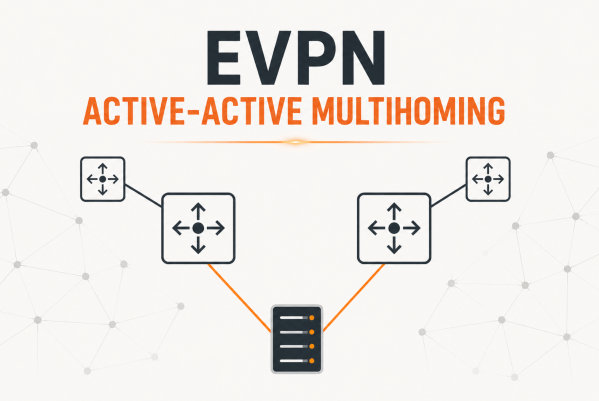
EVPN Active-Active Multihoming (EVPN-MH) takes a different approach. Instead of relying on proprietary control planes between switches, EVPN uses BGP EVPN itself to advertise multihoming information throughout the fabric. The result is a standards-based solution that provides redundancy, load balancing, faster convergence, and better scalability for modern VXLAN fabrics.
Continue reading “EVPN Active-Active Multihoming in Data Center Fabrics”