Intent-based networking is a hot new topic in the networking industry right now, but what really is intent-based networking? Watch my video to find out more.
networking | writing | teaching
There are a small variety of methods to implement failover of your WAN perimeter between two ISPs. In this post we’ll look at one way to accomplish this goal with a few technical requirements.
Keep in mind that there are several ways to accomplish this same goal depending on the hardware available, the flexibility of the ISPs, and the skill level or preference of the engineer.
This topology utilizes two edge routers and two ISPs instead of the single edge router design I wrote about recently (you can read that here). For this post we’re using Cisco routers, but the concepts apply universally. Our requirements are that we maintain connectivity from our inside host to the internet in the event one of the company routers fails or one of the ISPs fails. Failover and fail-back must be automatic with no manual intervention.
Continue reading “Dual WAN Router with Dual ISP Using BGP and OSPF”
Whitebox switches make use of generic and generally inexpensive hardware along with a network operating system that can be purchased and installed separately. Often the hardware and software come from different vendors, and there are several reasons this practice is becoming more common especially in the data center. What I’m interested in lately is how this is relevant to the non-webscale enterprise.
SD-WAN as a Service is coming to the marketplace as something to be be consumed, not owned. IT decision makers just want an ethernet handoff, and a managed WAN is already a common professional service, so for the typical IT manager, the case for SD-WAN as a Service is ease of use and cost savings. Very little else.
Continue reading “SD-WAN as a Service: Just Give Me an Ethernet Handoff”
Check out the first Network Collective video podcast, Top 10 Ways to Break Your Network, in which experienced network engineers share their most memorable blunders and the lessons learned from them.
Here’s the website: http://thenetworkcollective.com/
The header image was used with permission from Michael Nelson who was one of the Twitter participants during the first show. Check out his site here.
If you haven’t heard, the networking community is awesome. I’ve made some great friends, developed strong new relationships, and I’ve had the incredible luxury to bounce ideas off some seriously talented people. However, whether it’s through various Slack groups, Google hangouts, or private email chains, it’s all been relatively private. Not much makes its way onto Twitter, and not as much as I’d like makes it into blog posts.
No Networking Field Day would be complete without a presentation from an SD-WAN vendor. The technology is now established and maturing into a ubiquitous WAN solution across small and large enterprises alike, so at the upcoming Networking Field Day 15, I’ll be focused on how TELoIP, one of the presenters at the event, differentiates itself from its competitors.
IP Infusion has been around for a while, but the conversation in the industry about white box networking is bringing what IP Infusion does to the main stage. They’ll be presenting at Networking Field Day 15, and I’m looking forward to hearing how they’re progressing in this space.
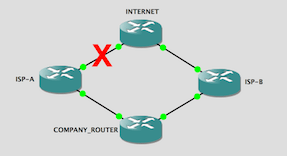
Sometimes political, financial, or logistical hurdles determine how we solve networking problems. In these tricky situations we may not be able to solve the problem the way we’d prefer, but we still need to solve the problem.
In this post I’m going to look at how we can solve a WAN failover scenario when we have a default route learned from both of our service providers and a reachability problem via our primary ISP.
Continue reading “BGP Default Route Failover Using Reachability”
I’ve been thinking a little bit about the Amazon S3 incident. Not really the incident, actually, but the responses to it. More than once I read something along the lines of “I’m sure that guy got fired” with regard to the engineer who entered the fatal command.
Sure, that’s kind of funny for a quick tweet or in the greater context of a blog post on change control, but for me, I’m not sitting at my desk shaking my head right now. Instead, I’m reminded about the times I did the exact same thing (on a much smaller scale) and will probably do it again.
About a thousand years ago, rather than configure routers, I taught high school English.
One day, instead of unpacking our favorite Shakespearean sonnet, I was sidetracked by a student who asked me how we know anything about electrons and how they orbit the nucleus of an atom. Apparently he asked his physics teacher the period before and got a pithy “electrons are the essence of a negativity.”
Cisco’s DMVPN Phase 3 protocol offers many benefits, but make sure you evaluate options before using OSPF. Read the rest of the article at Tech Target’s SearchNetworking site.
Here’s a list of carefully thought-out pairings of songs for specific types of network activities like cutovers, refresh projects, and typical pain-in-the-butt network tasks.
Click on the network-y activity to listen, and make sure to have your sound at a decent volume. Most of these tasks take longer than the length of one typical song, so usually I’m listening to the entire album.
Among the many lessons I’ve learned about being a property owner and landlord, one stands out as clear as day:
Don’t put off minor maintenance.
Read the article at the Packet Pushers site.
Tap everywhere. Tap everything. Trustworthy visibility is the key to network monitoring and security.
This is Ixia’s approach for how networking professionals can get an accurate picture of what’s really going in the network, and this was the theme of Ixia’s presentation at Networking Field Day 13.
Continue reading “Trust But Verify: Lossless End-To-End Visibility from Ixia”
Apstra, Incorporated isn’t focused on new features, more advanced silicon, or some new widget. Instead, they’re offering a different way to look at networking. Apstra offers an early form of intent-driven networking that abstracts network programmability and allows network engineers to configure intent rather than device features. We expect the network to behave in a specific way, so we configure our intent accordingly. I was very excited to meet the Apstra team at Networking Field Day 13, and they didn’t disappoint.
Continue reading “Apstra: The Intent-Driven Cure for Network Blindness”
It looks like we’re going to have some SD-WAN goodness next week at Networking Field Day 13. I love the technology itself because of the real-world use case and practical benefits a good SD-WAN solution can offer. Many of the SDN-labeled offerings out there are still a little immature, but adding intelligence to the WAN edge is something that is already being adopted wholeheartedly in even small enterprises.
Continue reading “SD-WAN with VeloCloud at Networking Field Day 13”
In a couple weeks I’ll be headed to sunny San Jose for Networking Field Day 13. If you’re not familiar with Networking Field Day and other Field Day events, check out their website, YouTube channel, Twitter feed, and LinkedIn page. Tech Field Day does a great job bringing technology influencers, bloggers, and craft beer enthusiasts together with some of the biggest and newest names in the tech industry.
I’m particularly interested in Apstra’s presentation on Thursday afternoon. I recently wrote an article about intent-driven networking, something of particular interest to me, so I’m really interested to hear what they have to say about their platform, the Apstra Operating System, or AOS.
Continue reading “Intent-Driven Networking with Apstra at Networking Field Day 13”
For the last 18 months or so I’ve been studying for the CCIE R&S. I took about 4 months off recently to focus on other technology, and right now I’m back at it with a schedule and pace that seems to be working very well for me so far.
There’s a new story being told in the networking industry. The CCIE isn’t what it used to be, and pursuing it doesn’t make as much sense as in years past. My initial response to this is simple: BALONEY.